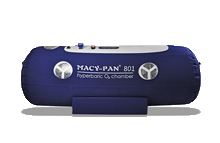
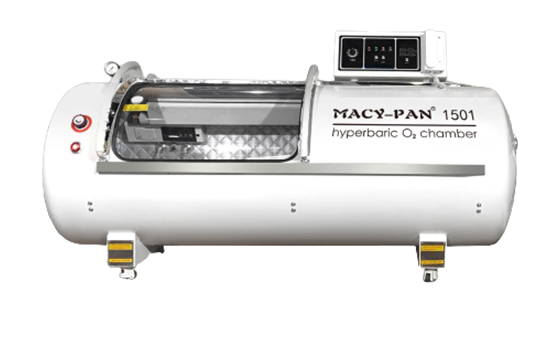
Hyperbaric Oxygen Therapy (HBOT) is becoming an increasingly recognized adjunctive therapy in veterinary medicine. By exposing an animal to increased atmospheric pressure while delivering oxygen at a controlled concentration, HBOT can increase oxygen availability to tissues and may support wound healing, recovery from certain injuries, and the management of selected veterinary conditions.
For veterinary hospitals, rehabilitation centers, specialty practices, and pet owners exploring advanced treatment options, choosing the right animal hyperbaric chamber requires more than simply comparing chamber size or operating pressure. Safety systems, oxygen delivery, visibility, patient monitoring, temperature control, and ease of operation all matter.
This guide explains how veterinary HBOT works, what conditions it may support, what a typical treatment involves, and what to consider when choosing a hyperbaric oxygen chamber for dogs and other animals.
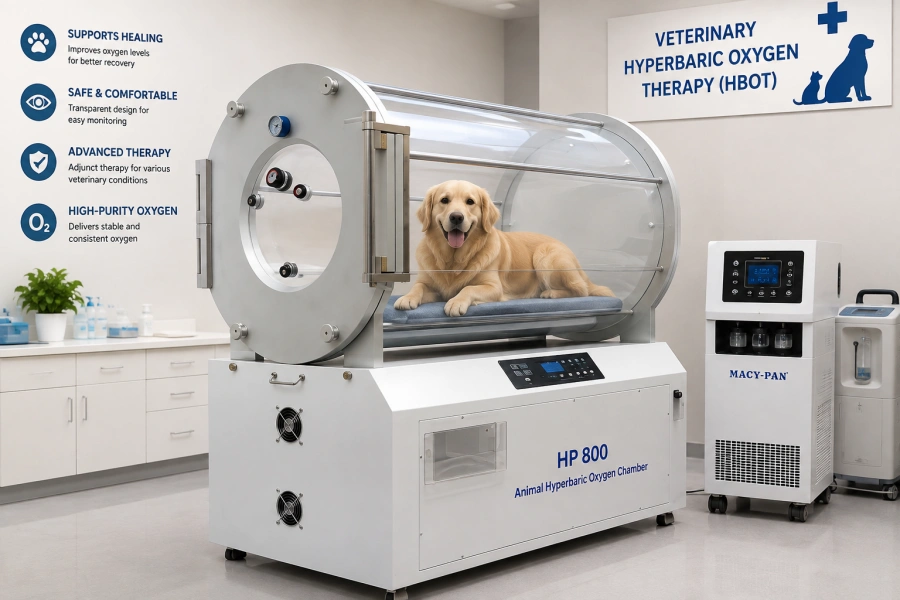
An animal hyperbaric chamber is a pressurized enclosure designed to provide hyperbaric oxygen therapy to veterinary patients.
Inside the chamber, atmospheric pressure is increased above normal sea-level pressure while the animal receives oxygen according to the treatment protocol.
Under increased pressure, more oxygen can dissolve in blood plasma and other body fluids. This can increase oxygen availability to tissues, including areas where circulation or oxygen delivery may be compromised.
At the tissue level, increased oxygen availability may support physiological processes associated with:
Tissue oxygenation
Wound healing
Angiogenesis
Reduction of edema
Certain immune functions
Recovery of oxygen-deprived tissue
The actual response depends on the animal, underlying condition, treatment pressure, oxygen concentration, treatment duration, and overall clinical protocol.
Importantly, veterinary HBOT is generally used as an adjunctive therapy. It is not intended to replace surgery, medication, wound management, rehabilitation, or other appropriate veterinary treatment.
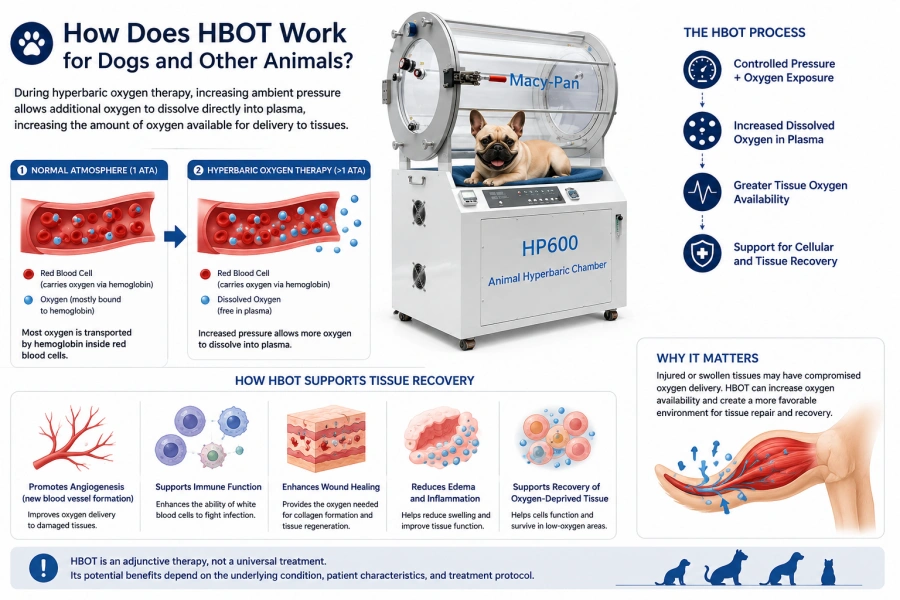 Under normal atmospheric conditions, most oxygen in the blood is transported by hemoglobin inside red blood cells.
During hyperbaric oxygen therapy, increasing ambient pressure allows additional oxygen to dissolve directly into plasma. This can increase the amount of oxygen available for delivery to tissues.
A simplified explanation is:
Controlled pressure + oxygen exposure → increased dissolved oxygen → greater tissue oxygen availability → support for cellular and tissue recovery
This mechanism is particularly relevant when injured or swollen tissue has compromised oxygen delivery.
Increased oxygen availability may create a more favorable environment for certain processes involved in tissue repair and recovery.
However, HBOT should not be viewed as a universal treatment. Its potential benefits depend on the underlying condition, patient characteristics, and treatment protocol.
Veterinary HBOT has been used or investigated as an adjunctive treatment for a range of conditions.
However, the level of clinical evidence is not the same for every application. Veterinary teams should evaluate HBOT based on the individual patient's condition and the available clinical evidence.
Oxygen plays an important role in tissue repair.
HBOT may support healing in selected wounds, burns, compromised tissue, and certain surgical wounds by increasing oxygen availability to affected areas.
Veterinary teams may consider HBOT when tissue oxygenation is a particular concern or when additional supportive therapy is appropriate alongside conventional wound management.
Some veterinary practices incorporate HBOT into postoperative recovery and rehabilitation protocols.
Increased tissue oxygen availability and potential effects on edema may support recovery following selected surgical procedures.
HBOT should complement—not replace—appropriate postoperative monitoring, pain management, infection control, wound care, and rehabilitation.
Traumatic injuries can involve tissue damage, swelling, and impaired oxygen delivery.
For selected injuries, HBOT may be considered as part of a broader treatment strategy where improving tissue oxygen availability is clinically appropriate.
Veterinary HBOT has also been explored in selected neurological injuries, including some cases involving traumatic brain or spinal cord injury.
Conditions such as Intervertebral Disc Disease (IVDD) require individualized veterinary assessment. HBOT should not be presented as a standalone treatment for IVDD, stroke, or other neurological disorders.
Increased tissue oxygen availability may support certain oxygen-dependent immune processes and can complement conventional treatment in selected cases.
HBOT has therefore been used as adjunctive therapy for some difficult-to-treat infections, including certain cases of osteomyelitis.
Depending on the veterinary practice and clinical protocol, HBOT may also be considered for other conditions involving compromised tissue oxygenation.
Because evidence and treatment protocols vary, a veterinarian should determine whether HBOT is appropriate for a particular patient.
When appropriately indicated and performed using suitable equipment and established safety procedures, HBOT can be administered safely to many veterinary patients.
However, like any medical intervention, HBOT is not completely risk-free.
Pressure changes during compression and decompression are important considerations.
Potential complications may include:
Ear or sinus discomfort
Pressure-related injury or barotrauma
Temporary anxiety or stress
Oxygen-related complications associated with inappropriate exposure
Rare neurological or pulmonary complications
Risk depends on factors including treatment pressure, oxygen concentration, exposure duration, patient health, and treatment protocol.
An oxygen-enriched environment requires strict fire-safety procedures.
Veterinary facilities operating hyperbaric equipment should establish procedures covering:
Oxygen handling
Electrical equipment
Materials permitted inside the chamber
Static electricity control
Emergency procedures
Equipment inspection
Operator training
The manufacturer's operating and safety instructions should always be followed.
Not every animal is an appropriate candidate for HBOT.
Before treatment, a veterinarian should assess the animal's condition, overall health, potential risks, and expected benefits.
Treatment pressure, oxygen concentration, session duration, and treatment frequency should be selected according to the patient's needs and the applicable clinical protocol.
A typical veterinary HBOT session involves several stages.
The veterinary team evaluates the animal and determines whether HBOT is appropriate.
The animal is prepared according to the facility's safety protocol.
Items that could create a fire, oxygen, or equipment hazard should not be placed inside the chamber.
The animal enters the chamber and is positioned comfortably.
A transparent chamber can make visual monitoring easier and may help some animals remain calmer because they can maintain visual contact with people outside the chamber.
Pressure is gradually increased to the selected treatment level.
Controlled compression can help manage pressure-related discomfort.
The animal receives oxygen according to the treatment protocol.
During treatment, the veterinary team monitors the patient and chamber conditions.
At the end of the treatment, pressure is gradually reduced toward normal atmospheric pressure.
The veterinary team evaluates the animal after treatment and determines whether additional sessions are appropriate.
Treatment duration varies according to:
The animal's condition
Treatment objective
Pressure
Oxygen concentration
Chamber configuration
Veterinary protocol
Many veterinary HBOT sessions may last approximately one to two hours, but this should not be treated as a universal protocol.
The total number of treatments can also vary considerably.
Some cases may involve a limited number of sessions, while others may require repeated treatments over a longer period.
The appropriate treatment schedule should be determined by the attending veterinarian rather than by equipment specifications alone.
For veterinary hospitals, rehabilitation centers, and specialty practices, selecting an HBOT system requires consideration of clinical requirements, engineering specifications, patient comfort, workflow, and safety.
Operating pressure is one of the most important specifications.
Veterinary HBOT systems may use relatively low hyperbaric pressures depending on the treatment protocol and equipment design.
Rather than assuming that higher pressure is automatically better, buyers should evaluate:
Available pressure range
Pressure control
Pressurization speed
Decompression control
Pressure stability
Safety mechanisms
A 1.4 ATA system can be suitable for veterinary applications where a low-pressure HBOT protocol is appropriate. However, pressure should ultimately be selected according to the clinical protocol and veterinarian's assessment.
The chamber should be paired with an appropriate oxygen delivery system.
Depending on the configuration, this may include an oxygen concentrator or another controlled oxygen source.
Important specifications include:
Oxygen concentration
Flow rate
System compatibility
Reliability
Maintenance requirements
Buyers should also understand exactly how oxygen is delivered within the selected chamber configuration.
Animals can become anxious when placed in unfamiliar enclosed environments.
A transparent chamber provides an important practical advantage: veterinary staff can maintain visual contact with the patient throughout treatment.
This can also make routine visual observation easier.
However, transparency should not be interpreted as a guarantee that every animal will tolerate HBOT without behavioral support or sedation.
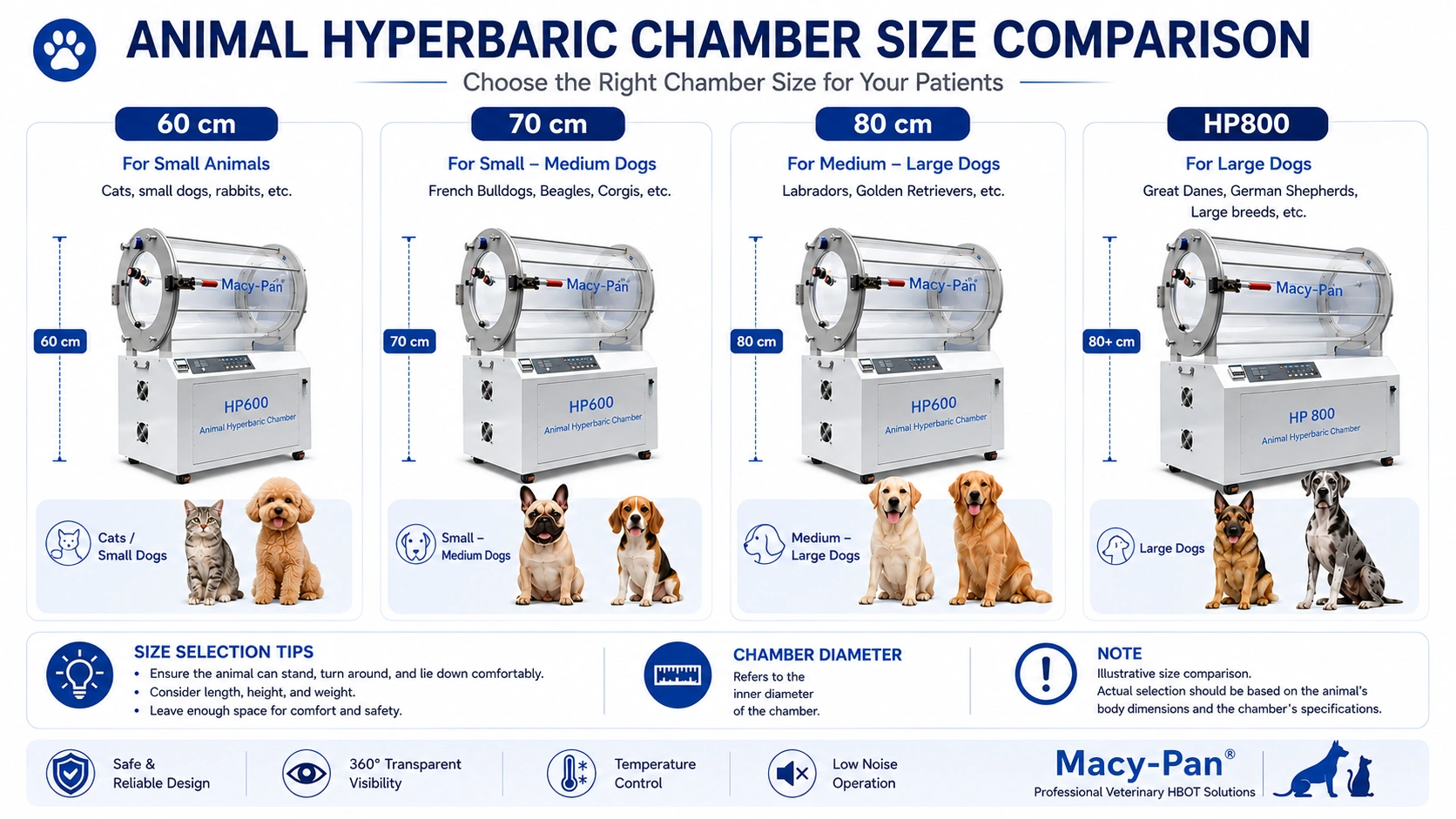
Chamber size should match the animals the facility expects to treat.
A chamber suitable for small dogs and cats may not provide sufficient space for large breeds.
Consider:
Animal length
Animal height
Ability to reposition
Comfortable resting space
Operator access
Cleaning requirements
For practices treating larger dogs, a larger chamber configuration can provide greater flexibility.
HBOT sessions may last for an extended period, making patient comfort an important operational consideration.
An integrated cooling system can help maintain a more comfortable chamber environment, particularly for facilities performing multiple treatments per day.
Visibility is only one part of patient monitoring.
When evaluating an animal hyperbaric chamber, buyers should also consider:
Visual patient monitoring
Pressure monitoring
Communication
Emergency depressurization
Operator controls
Alarm systems, where applicable
A clear emergency procedure should be established before the equipment is placed into routine clinical use.
Veterinary equipment is exposed to fur, dander, moisture, and biological contaminants.
The chamber should therefore support practical cleaning and routine maintenance.
Ask the supplier about:
Cleaning procedures
Replacement components
Maintenance intervals
Technical support
Warranty
Operator training
Long-term serviceability should be considered alongside the initial equipment price.
The intended environment should strongly influence equipment selection.
A veterinary hospital or rehabilitation center may require:
Higher patient throughput
Different chamber sizes
Staff training
Patient monitoring
Standardized treatment procedures
Technical and maintenance support
Clinic-based equipment may therefore prioritize durability, workflow efficiency, versatility, and ease of operation.
Home HBOT introduces additional safety and operational considerations.
Pet owners should not assume that a hyperbaric chamber can be operated safely without appropriate instruction or veterinary guidance.
Before considering home HBOT, users should understand:
Whether the equipment is appropriate for the intended animal
Required operator training
Veterinary supervision
Oxygen and fire-safety requirements
Emergency procedures
Cleaning and maintenance requirements
For medical applications, professional veterinary guidance should remain central to the treatment decision.
Unlike human patients, animals cannot always understand why they are being placed inside medical equipment.
Patient behavior can therefore become an important factor in treatment.
A transparent acrylic chamber allows the animal to maintain visual contact with veterinary staff or owners during treatment.
This may help reduce anxiety for some animals while also making visual monitoring easier.
However, transparent construction does not guarantee that sedation will never be necessary.
Whether sedation, restraint, or another behavioral-management approach is appropriate should be determined by the veterinary team.
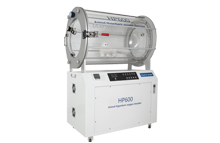
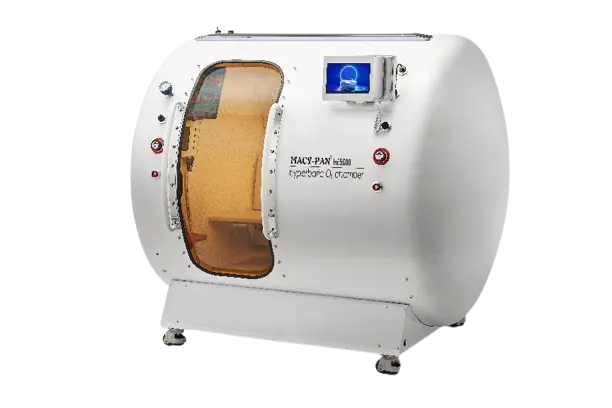
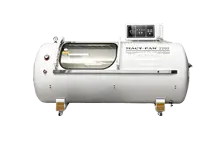
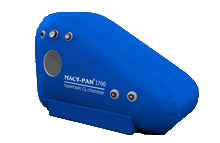
When evaluating veterinary HBOT equipment, MACY-PAN focuses on several practical requirements that matter to veterinary facilities: controlled pressure, patient visibility, different chamber sizes, and integrated supporting equipment.
MACY-PAN veterinary chamber configurations are designed around a 1.4 ATA operating pressure, providing a controlled low-pressure hyperbaric environment for appropriate veterinary applications.
The appropriate treatment protocol should still be determined by the veterinary team.
The transparent chamber design allows animals to maintain visual contact with veterinary staff or owners during treatment.
It also facilitates visual observation throughout the session.
Different chamber diameters can accommodate different patient sizes.
MACY-PAN configurations include 60 cm, 70 cm, and 80 cm options, while the larger HP800 configuration provides additional space for larger dogs.
The correct size should be selected according to the animals a facility expects to treat.
Depending on the configuration, MACY-PAN systems can incorporate supporting equipment such as:
Air compressor
Oxygen concentrator
Cooling system
An integrated configuration can simplify equipment selection and installation for veterinary facilities.
Before purchasing an animal hyperbaric chamber, veterinary practices can use the following checklist.
What types of animals will be treated?
What conditions will the chamber support?
What treatment protocols will be used?
How many treatments are expected per week or month?
What pressure range is available?
What chamber size is required?
Is the chamber transparent?
Can the animal comfortably reposition itself?
Is the chamber suitable for the expected patient population?
What oxygen source is included?
What oxygen concentration can be achieved?
What flow rate is available?
How is oxygen delivery controlled?
What oxygen-safety procedures are required?
What emergency release systems are available?
How is pressure controlled?
What operator training is provided?
What safety documentation is supplied?
How easy is the chamber to clean?
How long does a typical treatment take?
What daily treatment volume can the facility support?
Is cooling included?
How much floor space is required?
Warranty
Technical support
Spare parts
Training
Installation assistance
After-sales service
A complete evaluation of these factors is generally more useful than comparing purchase price alone.
The economics of a veterinary hyperbaric chamber depend heavily on location, equipment configuration, treatment pricing, patient volume, staffing, maintenance, and utilization.
Instead of relying on a universal treatment price or guaranteed payback period, veterinary practices should calculate their own potential return.
A simplified model is:
Monthly HBOT Revenue = Average Treatment Price × Number of Treatments per Month
Potential payback can then be estimated by comparing the equipment investment with the contribution generated by HBOT services.
Estimated Payback Period = Equipment Investment ÷ Monthly Contribution
Actual results will depend on:
Equipment purchase price
Local treatment rates
Number of patients
Treatments per patient
Staff time
Electricity consumption
Oxygen consumption
Maintenance
Facility costs
For a more realistic business case, practices should also consider equipment depreciation, financing costs, staff utilization, and downtime.
What is an animal hyperbaric chamber?
An animal hyperbaric chamber is a pressurized enclosure used to provide hyperbaric oxygen therapy to veterinary patients. Increased atmospheric pressure can increase the amount of oxygen dissolved in body fluids and may support tissue recovery in selected conditions.
How does HBOT work for dogs?
HBOT increases ambient pressure while providing controlled oxygen exposure. This can increase dissolved oxygen in plasma and improve oxygen availability to tissues.
What conditions can HBOT help treat in dogs?
Veterinary HBOT may be used as an adjunctive therapy for selected wounds, burns, traumatic injuries, postoperative recovery, certain infections, and some neurological conditions. Treatment suitability depends on the individual patient and veterinary assessment.
Is hyperbaric oxygen therapy safe for dogs?
HBOT can be administered safely when appropriate equipment, treatment protocols, patient selection, and safety procedures are used. Potential risks include pressure-related injury and oxygen-related complications, so veterinary supervision is important.
Do dogs need sedation in a hyperbaric chamber?
Not necessarily. Some animals tolerate HBOT without sedation, but tolerance varies according to temperament, medical condition, chamber design, and treatment environment.
The veterinary team should determine whether sedation or another behavioral-management approach is appropriate.
How long does a dog stay in a hyperbaric chamber?
A veterinary HBOT session may commonly last around one to two hours, but treatment duration varies according to the patient and clinical protocol.
How many HBOT sessions does a dog need?
There is no universal number of sessions. Treatment frequency and total treatment duration depend on the condition being treated and the veterinarian's clinical assessment.
What pressure is used for veterinary HBOT?
Veterinary HBOT uses controlled hyperbaric pressures. Low-pressure systems such as 1.4 ATA are used in some veterinary applications, but the appropriate pressure should be selected according to the clinical protocol and equipment.
Can cats use an animal hyperbaric chamber?
Yes. Veterinary hyperbaric chambers can be used for cats when the chamber is appropriately sized and HBOT is considered suitable by the veterinary team.
Can a hyperbaric chamber be used at home?
Home-use HBOT requires careful consideration of equipment suitability, operator training, oxygen safety, emergency procedures, and veterinary supervision.
Pet owners should consult a veterinarian before using HBOT for a medical condition.
What should I look for when buying a veterinary hyperbaric chamber?
Key factors include:
Operating pressure
Oxygen delivery
Chamber size
Visibility
Safety systems
Temperature control
Patient monitoring
Cleaning and maintenance
Operator training
Warranty
Technical support
An animal hyperbaric chamber can be a valuable addition to veterinary hospitals, rehabilitation centers, and advanced pet-care facilities when incorporated into an appropriate clinical protocol.
The best equipment is not necessarily the chamber with the highest pressure or the lowest purchase price.
Instead, veterinary practices should evaluate the complete system—including patient safety, chamber size, oxygen delivery, visibility, temperature control, monitoring, maintenance, and supplier support.
For practices looking to add veterinary HBOT capabilities, MACY-PAN provides transparent 1.4 ATA veterinary hyperbaric chambers in multiple size configurations, including the larger HP800 option for bigger dogs.
Looking for a veterinary hyperbaric chamber for your practice? Contact MACY-PAN to discuss chamber size, configuration, and application requirements.

Discount Price, ship by DHL, door to door service, 5-7days delivery time, local technical support

We supply soft and hard chambers from 1.3-2.0ATA to reach different customers' needs

Create custom uniquea hyperbaric chambers to reach your target market

We have more than 50 distributors around world, looking forward to having you on board.

 français
  Deutsch
  italiano
  العربية
  čeština
  Suomi
Suomi  Polska
  עברי
עברי