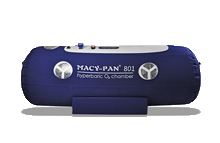
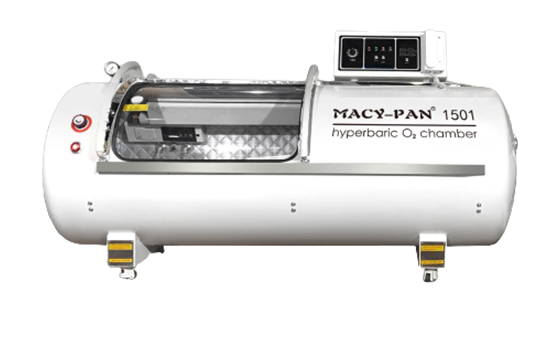
A Veterinary HBOT ROI & Cost Guide for Animal Hospitals and Rehabilitation Centers
For veterinary hospitals and rehabilitation centers looking to expand advanced treatment services in 2026, one question is becoming increasingly important:
Is a veterinary hyperbaric chamber worth the investment?
Hyperbaric oxygen therapy (HBOT) is increasingly being incorporated into veterinary rehabilitation, wound management, post-surgical recovery, neurological care, and other supportive treatment protocols. For practices that can maintain consistent patient utilization, a veterinary hyperbaric oxygen chamber may create a new revenue stream while expanding the range of services offered in-house.
But purchasing an HBOT system is a significant capital decision. Veterinary practice owners need to consider more than the purchase price. Treatment pricing, patient volume, operating costs, staffing, utilization rate, and the clinical applications supported by the chamber all influence the potential return on investment.
This guide explains the key factors veterinary hospitals and rehabilitation centers should evaluate when calculating the potential ROI of a veterinary hyperbaric chamber in 2026.
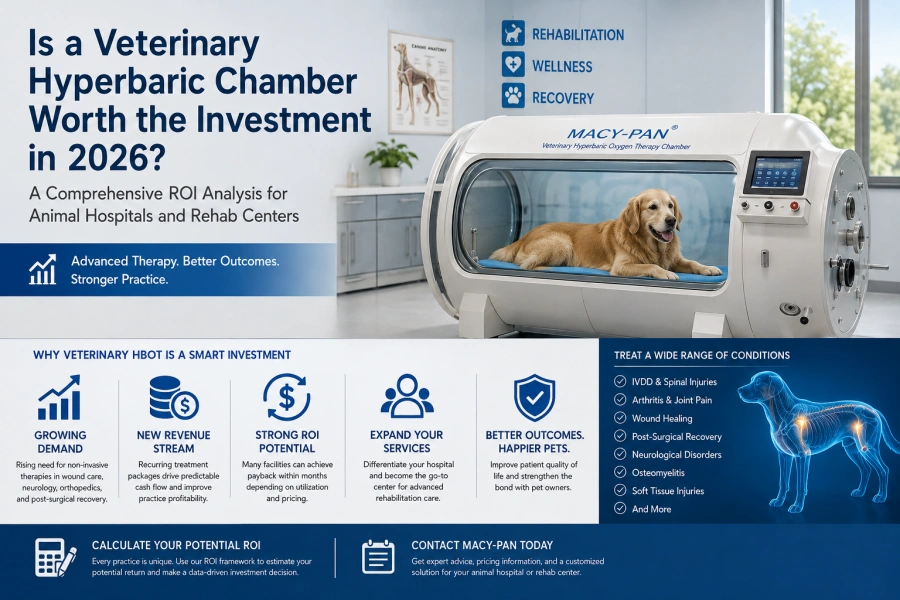
The business case for veterinary HBOT begins with clinical demand.
Hyperbaric oxygen therapy can be incorporated into veterinary care as an adjunctive therapy for a range of conditions, including:
Complex or difficult-to-heal wounds
Post-surgical recovery
Neurological injuries
Orthopedic rehabilitation
Soft-tissue injuries
Certain inflammatory conditions
Osteomyelitis and other selected clinical applications
Some treatment protocols involve multiple sessions rather than a single visit. This creates an important difference between HBOT and one-time procedures.
Instead of generating revenue from a single treatment event, a veterinary practice can potentially provide a structured series of HBOT sessions as part of an overall rehabilitation or recovery plan.
For example:
Initial assessment → Treatment plan → Multiple HBOT sessions → Progress evaluation → Follow-up care
This recurring treatment model can make HBOT particularly interesting for veterinary rehabilitation centers and hospitals that already have a steady flow of appropriate cases.
Important: HBOT should be positioned as a veterinary treatment modality used under appropriate professional supervision. The number and frequency of sessions should be determined by the treating veterinary professional based on the individual patient's condition.
One of the first questions veterinary business owners ask is:
How much can a clinic charge for veterinary HBOT?
The answer depends heavily on the local market, treatment protocol, chamber type, facility positioning, and the services included in each session.
Market pricing can vary substantially. Rather than assuming a universal treatment price, veterinary practices should conduct a local competitive analysis before establishing their HBOT pricing model.
A clinic may structure its HBOT service around:
Per-session pricing
Multi-session treatment packages
Rehabilitation programs
Post-operative recovery programs
Comprehensive wound-care protocols
Specialty veterinary care packages
To understand the potential economics, consider a hypothetical example:
Average treatment price: $150 per session
Average sessions per day: 5
Operating days: 5 days per week
The calculation would be:
$150 × 5 sessions × 5 days = $3,750 per week
At approximately 50 operating weeks per year:
$3,750 × 50 = $187,500 in gross annual treatment revenue
This is an illustrative revenue scenario, not a guaranteed result. Actual revenue depends on patient demand, chamber capacity, appointment scheduling, treatment pricing, downtime, staffing, and the percentage of available treatment slots that are actually utilized.
This distinction is critical when evaluating veterinary HBOT ROI.
A chamber's maximum daily capacity does not automatically translate into revenue.
The more important metric is:
For example, a chamber capable of supporting several treatment sessions per day may generate very different results at:
20% utilization
40% utilization
60% utilization
80% utilization
This makes patient acquisition and internal referrals just as important as the equipment itself.
Veterinary hospitals can potentially increase HBOT utilization by integrating the service into existing departments, including:
Patients receiving physical rehabilitation may also be evaluated for HBOT as an adjunctive therapy when clinically appropriate.
Post-operative orthopedic patients may represent another potential patient group for structured recovery programs.
Dogs recovering from neurological injuries or conditions may be evaluated for multimodal rehabilitation protocols that include HBOT.
Veterinary wound-care cases can create opportunities for repeated treatment sessions when HBOT is considered appropriate by the attending veterinarian.
This is why the business case should not simply ask:
“How much does the chamber cost?”
It should ask:
“How many appropriate HBOT cases can our hospital realistically generate each month?”
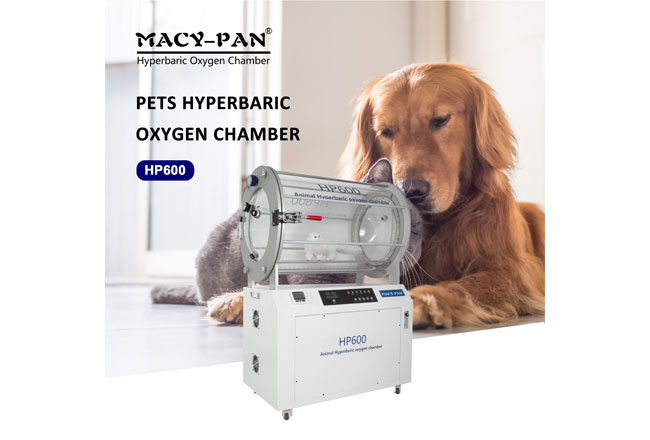
The purchase price is only one component of the total investment.
When evaluating a veterinary hyperbaric chamber, veterinary practices should consider:
Chamber purchase price
Installation
Facility requirements
Oxygen supply
Staff training
Routine maintenance
Safety procedures
Insurance and compliance requirements
Marketing and patient acquisition
Potential financing costs
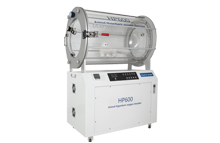
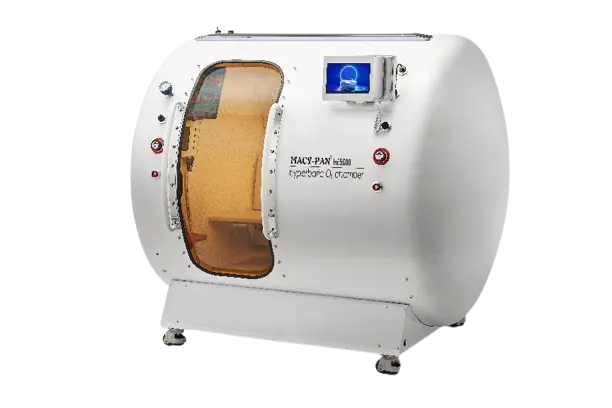
Equipment specifications can also vary significantly between chamber types.
For example, a practice may compare:
| Factor | Portable / Soft-Shell System | Hard-Shell Veterinary Chamber |
| Initial investment | Generally lower | Generally higher |
| Space requirements | Often more flexible | Typically greater |
| Treatment environment | Depends on system | More controlled |
| Potential applications | Selected rehabilitation and wellness applications | Broader clinical applications depending on configuration |
| Facility requirements | May be simpler | May require greater planning |
| Best fit | Practices testing or expanding services | Hospitals and dedicated rehabilitation centers |
Rather than selecting a chamber based solely on the lowest purchase price, practices should evaluate total cost of ownership and expected utilization.
A simple veterinary HBOT ROI model can start with four variables:
Equipment + installation + associated setup costs
Average amount charged for each HBOT treatment
Number of completed HBOT sessions per month
Oxygen + electricity + maintenance + labor + other service costs
A simplified calculation is:
Monthly Gross Revenue = Average Price Per Session × Number of Sessions
Then:
Monthly Operating Profit Contribution = Gross Revenue − Incremental Operating Costs
And:
Estimated Payback Period = Initial Investment ÷ Monthly Operating Profit Contribution
This is a much more useful approach than quoting a universal “3-month” or “6-month” payback period because every veterinary practice has a different patient volume and pricing structure.
Consider a hypothetical veterinary rehabilitation center investing:
$40,000 in equipment and setup
If the clinic generates an average contribution of:
$100 per completed treatment after variable costs
The clinic would need approximately:
400 treatments
to recover the initial investment.
If the center completes:
100 treatments per month
the theoretical payback period would be approximately:
4 months
At:
50 treatments per month
the same investment would require approximately:
8 months
This demonstrates an important principle:
Veterinary HBOT ROI is driven primarily by utilization, pricing, and operating economics—not simply by the purchase price of the chamber.
For this reason, MACY-PAN should avoid promising a fixed payback period and instead help prospective buyers calculate their own potential economics.
There is another financial factor that veterinary hospitals often overlook:
Suppose a hospital identifies patients who could potentially benefit from veterinary HBOT but does not have an in-house chamber.
Those patients may be referred to:
Specialty veterinary hospitals
Rehabilitation centers
Veterinary sports medicine facilities
Independent HBOT providers
The hospital may lose more than the HBOT treatment revenue.
It may also lose:
Follow-up visits
Rehabilitation services
Diagnostic services
Additional treatment opportunities
Long-term client relationships
For example, if a hypothetical patient receives 20 HBOT sessions at $200 per session, the associated treatment revenue would be:
20 × $200 = $4,000 per patient
If a practice sees 50 such patients in a year, the gross treatment value would be:
50 × $4,000 = $200,000
Again, this is an illustrative calculation rather than a prediction of actual clinic revenue.
The strategic point is more important:
If your hospital has sufficient demand for HBOT, referring appropriate cases elsewhere may represent a significant opportunity cost.
The financial value of a veterinary hyperbaric chamber is not limited to direct treatment revenue.
Adding HBOT can potentially help a veterinary hospital position itself as a more comprehensive rehabilitation and advanced-care provider.
Instead of offering isolated services, a practice can build a broader rehabilitation ecosystem:
Veterinary Consultation
↓
Diagnostic Evaluation
↓
Surgical / Medical Treatment
↓
Physical Rehabilitation
↓
HBOT as an Adjunctive Therapy
↓
Follow-Up & Recovery Monitoring
This integrated approach may be particularly attractive to owners of senior dogs, athletic dogs, working dogs, and pets recovering from surgery or injury.
Purchasing the equipment is only the beginning.
The practices most likely to achieve strong utilization should develop a clear commercialization and clinical workflow.
Train veterinarians and rehabilitation professionals to recognize appropriate HBOT referral opportunities.
Where clinically appropriate, multi-session programs can make scheduling more predictable than relying entirely on individual appointments.
Position HBOT as part of a broader veterinary rehabilitation program rather than an isolated service.
Create educational content around:
IVDD rehabilitation
Senior dog recovery
Wound management
Post-surgical recovery
Canine sports injuries
Neurological rehabilitation
Monitor:
Available treatment slots → Booked sessions → Completed sessions → Revenue per session → Monthly revenue
This allows the hospital to identify whether the biggest opportunity is increasing patient volume, improving scheduling, adjusting pricing, or expanding referral channels.
For the right veterinary hospital or rehabilitation center, it can be.
The strongest business case generally exists when a practice has:
A sufficient volume of appropriate cases
An established rehabilitation or specialty-care department
The ability to schedule multiple treatment sessions
A clear pricing strategy
Appropriate trained staff
A facility capable of safely operating the equipment
A long-term plan for patient acquisition and utilization
The key question is therefore not:
“Is a veterinary hyperbaric chamber profitable?”
It is:
“Can our practice generate enough appropriate HBOT treatments to make the investment economically viable?”
That is the question every hospital should answer before purchasing equipment.
Before investing in a veterinary hyperbaric chamber, calculate your own numbers.
Enter:
Average price per session: $_____
Expected sessions per day: _____
Operating days per month: _____
Expected monthly sessions: _____
Equipment & installation investment: $_____
Estimated monthly operating costs: $_____
Then calculate:
Average session price × Monthly sessions
Monthly gross revenue − Monthly operating costs
Initial investment ÷ Monthly contribution
This simple model can help veterinary hospitals compare different equipment configurations and determine whether an HBOT program fits their business model.
ROI should never be evaluated separately from equipment performance and safety.
When comparing veterinary HBOT systems, consider:
Chamber construction
Operating pressure
Oxygen delivery system
Monitoring capabilities
Safety features
Control and automation
Chamber capacity
Ease of operation
Cleaning and maintenance
Staff training requirements
Manufacturer support
Warranty and after-sales service
For hospitals planning to treat a higher volume of patients, workflow efficiency and operational reliability can have a direct impact on long-term ROI.
A lower-cost chamber that is difficult to operate or maintain may not necessarily provide the best economic outcome.
Veterinary hyperbaric oxygen therapy represents an opportunity for animal hospitals and rehabilitation centers to combine advanced patient care with a potential new revenue stream.
The strongest investment case is not based on an industry-wide promise of a specific payback period. Instead, it depends on the individual practice's:
Patient demand + Treatment pricing + Utilization + Operating costs + Equipment investment
For a facility with sufficient clinical demand and a well-planned HBOT workflow, bringing the service in-house can potentially reduce external referrals, expand rehabilitation capabilities, and create recurring treatment revenue.
The next step is to calculate the numbers for your own facility.
Interested in adding veterinary HBOT to your animal hospital or rehabilitation center? Contact MACY-PAN to discuss veterinary hyperbaric chamber options, facility requirements, and a customized equipment solution.

Discount Price, ship by DHL, door to door service, 5-7days delivery time, local technical support

We supply soft and hard chambers from 1.3-2.0ATA to reach different customers' needs

Create custom uniquea hyperbaric chambers to reach your target market

We have more than 50 distributors around world, looking forward to having you on board.

 français
  Deutsch
  italiano
  العربية
  čeština
  Suomi
Suomi  Polska
  עברי
עברי