For athletes considering hyperbaric oxygen therapy (HBOT), the practical questions are straightforward: what can pressurized oxygen realistically do for recovery, how much does access cost, and which specifications matter when buying a home chamber? Clinic sessions are commonly marketed in the hundreds of dollars per visit, while home systems span from entry-level mild-pressure soft chambers to premium hard-shell installations costing tens of thousands of dollars. The potential value is not a guaranteed performance boost; it is a controlled increase in oxygen availability that may support selected recovery processes. Evidence in sports remains developing, so we recommend treating HBOT as an adjunct—not a replacement for diagnosis, rehabilitation, sleep, nutrition, or evidence-based injury care.
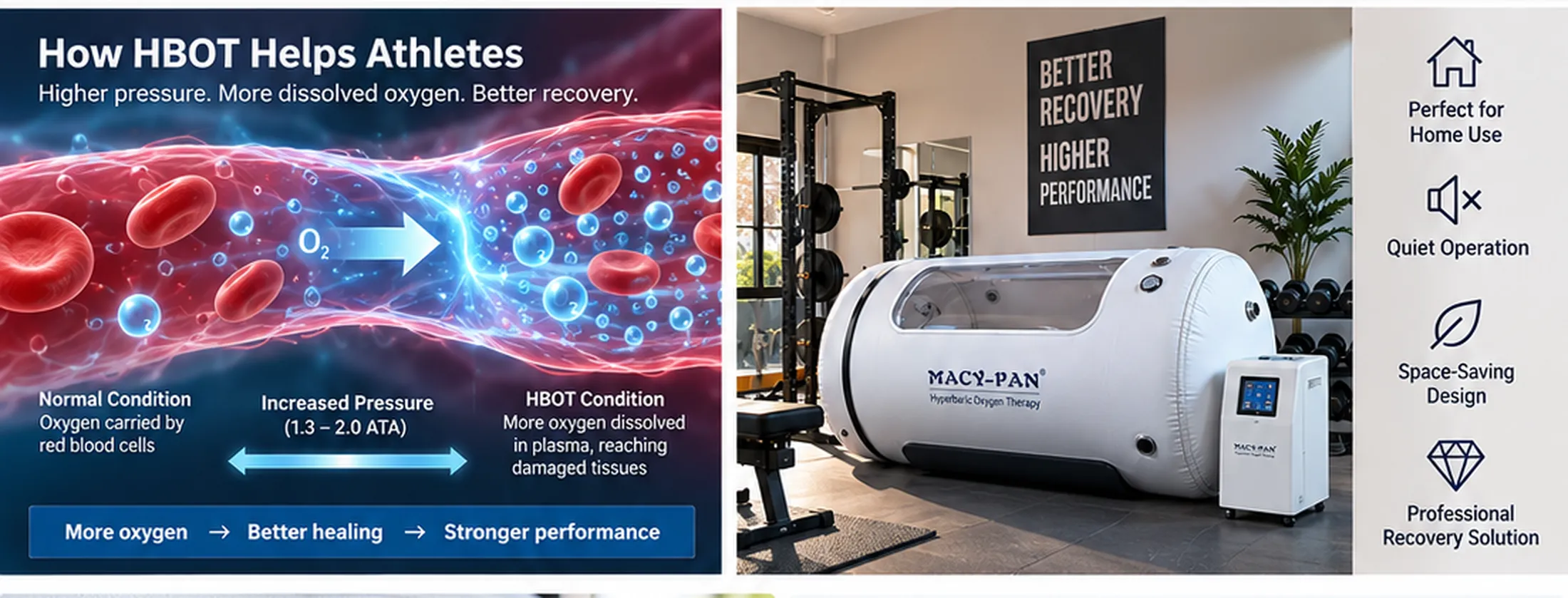
HBOT exposes the body to pressure above normal atmospheric pressure while oxygen is delivered at an elevated concentration. The important physiological distinction is not simply that the lungs receive “more oxygen.” Under pressure, Henry’s law predicts that more oxygen can dissolve directly into the liquid component of blood plasma. This dissolved oxygen can contribute to oxygen delivery beyond the oxygen carried by hemoglobin, including in tissues where edema, inflammation, vascular compromise, or injury has impaired local microcirculation.
That mechanism is why athletes and recovery-focused consumers are interested in HBOT after demanding training blocks or injury. However, mechanisms should not be confused with guaranteed clinical outcomes. Research on sports performance and recovery is much smaller and less standardized than the evidence base for established medical indications for HBOT.
Public interest has also been driven by reports of professional athletes using hyperbaric chambers. Business Insider has discussed athletes and celebrities associated with the technology, including LeBron James, Russell Wilson, Novak Djokovic, Tom Brady and Joe Namath. See the Business Insider report. Their use demonstrates adoption among elite performers, but celebrity or athlete use is not itself evidence that HBOT improves performance.
At sea level, hemoglobin already carries most arterial oxygen. Raising ambient pressure and inspired oxygen increases the partial pressure of oxygen and, consequently, the amount physically dissolved in plasma. In clinical hyperbaric medicine, this hyperoxic exposure is associated with effects on oxygen gradients, edema, inflammatory signaling, angiogenesis and wound-healing pathways. Collagen synthesis is oxygen-dependent, which is one reason oxygen availability is biologically relevant to tissue repair.
A frequently cited athlete study conducted across 2018–2020 used a course of 40 HBOT sessions—five sessions per week, approximately one hour per session, with 100% oxygen—and reported significant improvements in maximal oxygen consumption and anaerobic threshold. This is interesting but should not be generalized into a universal athletic prescription: protocol, participant characteristics, training status and study design all influence outcomes.
In practice, elite athletes tend to place HBOT inside a broader recovery stack: physiotherapy, sleep management, nutrition, cold or heat modalities, compression, mobility work and medical treatment when an injury is present. Reported use cases range from recovery between NFL games to recovery support during dense tennis competition schedules. The rational use case is therefore not “HBOT makes you faster overnight,” but “HBOT may be one controlled recovery input when training and competition leave limited recovery time.”
HBOT Physiological Benefits Breakdown
Target Area | Physiological Mechanism | Expected Athletic Benefit |
Soft Tissue Repair | Increased oxygen tension; oxygen-dependent collagen synthesis and angiogenic signaling | Potential support for tissue-repair processes |
Metabolic Recovery | Improved tissue oxygen availability and circulatory gradients | May support recovery between demanding sessions; direct lactate-clearance claims require caution |
Cognitive Function | Transient hyperoxia and increased oxygen availability | Possible subjective alertness; performance effects are not established for all athletes |
Inflammation / Edema | Hyperoxia-related vasoconstriction with maintained oxygen delivery; modulation of inflammatory pathways | Potential reduction of swelling in selected clinical contexts |
The hyperbaric chamber price per session varies sharply by country, facility, chamber type, supervision and whether treatment is medically indicated. Third-party clinic pricing commonly cited in the market falls around $250–$600 per session. Community reports, including some patients seeking lower-cost access for conditions such as traumatic brain injury, have described prices near $80 in lower-cost settings. These figures are market observations rather than standardized medical tariffs, so athletes should request a written quotation and clarify whether physician assessment, oxygen delivery and monitoring are included.
Repeated use changes the economics. At $300 per session, 20 visits equal $6,000 and 40 equal $12,000 before travel and time costs. That does not automatically make a home chamber the better choice: clinical supervision, pressure capability, oxygen delivery and medical suitability may be materially different.
Across the broader consumer and professional market, advertised chamber prices can range roughly from $7,499 to $129,000, depending on construction, pressure capability, occupancy, controls and installation. Soft chambers marketed to athletes are often quoted in the approximately $6,729–$15,900 range. Prices change, so these figures should be treated as comparison anchors rather than current binding offers.
Searches for “used hyperbaric chamber for sale” can reveal lower prices, but second-hand equipment deserves additional inspection: shell age, zipper integrity, pressure cycles, compressor condition, oxygen-concentrator hours, sanitation, replacement parts and warranty transferability all matter. Biohacking communities have also discussed Alibaba-sourced soft chambers around $1,000–$1,500. At that level, buyers must independently assess international freight, customs, electrical compatibility, documentation, service, parts and warranty risk.
Published or historically advertised prices provide useful anchors, although readers should verify current quotations directly with each manufacturer or distributor: Newtowne C4-27—$4,095; Newtowne C4-34—$5,795; OxyRevo Elite32—$7,499; OxyRevo Quest36—$23,799; Vitaeris 320—about $24,000 and marketed for users up to approximately 6 ft 10 in; OxyRevo Space60—$36,549. In the UK, customized multi-person installations can be dramatically more expensive; four-person chamber quotations have been advertised as high as approximately £88,000.
Model/Category | Chamber Type | ATA Pressure | Estimated Cost |
Newtowne C4-27 | Soft / mild chamber | Verify with supplier | $4,095 |
Newtowne C4-34 | Soft / mild chamber | Verify with supplier | $5,795 |
OxyRevo Elite32 | Soft chamber | Typically mild-pressure class | $7,499 |
OxyRevo Quest36 | Hard chamber | 1.5–2.0 ATA advertised range | $23,799 |
Vitaeris 320 | Soft / portable chamber | Verify with supplier | ~$24,000 |
OxyRevo Space60 | Large chamber | Verify with supplier | $36,549 |
Custom 4-person UK unit | Multi-person chamber | Configuration dependent | Up to ~£88,000 |
ATA means atmospheres absolute. Many soft chambers marketed for wellness and athletic recovery operate around 1.3–1.5 ATA. Hard-shell products can offer higher pressure; for example, the OxyRevo Quest36 is marketed in the 1.5–2.0 ATA range. Higher pressure is not automatically “better.” The optimal pressure and oxygen-delivery protocol for general sports recovery have not been established, and higher-pressure medical HBOT should be used under appropriate clinical oversight.
One of the most overlooked specifications is oxygen flow. A chamber’s pressure rating tells you very little about how much oxygen reaches the user. Some low-cost packages pair a chamber with a concentrator that provides only about 3 L/min under relevant operating conditions. If oxygen is delivered through a mask or cannula, insufficient flow, leakage and the user’s minute ventilation can substantially affect inspired oxygen concentration. Premium athlete-oriented configurations may use a genuine 10 L/min-class concentrator or dual-concentrator arrangements, but system design matters more than a marketing number. Ask for flow at operating pressure, oxygen purity at that flow, delivery interface and whether performance has been independently verified.
Buyers should verify which certifications apply to the actual product and manufacturing facility rather than accepting a generic logo sheet. ISO 9001, ISO 14001 and ISO 13485 are commonly referenced quality, environmental and medical-device quality-management standards, but an ISO certificate does not by itself prove that a chamber is legally cleared as a medical device in your country. Check the applicable regulatory status separately. For a substantial home purchase, we would also look for a written warranty of at least three years where available, defined coverage for the chamber and accessories, and a documented parts/service process.
Allow installation clearance rather than measuring only the chamber body. As a practical planning rule, leaving roughly 3–4 ft of working space where possible makes entry, compressor ventilation, hoses and maintenance easier. Follow the manufacturer’s specified ventilation and clearance requirements when they differ.
1. Compressor output: confirm airflow at the target operating pressure, not only free-air flow.
2. Oxygen system: verify L/min, oxygen concentration at rated flow, delivery interface and alarms.
3. Shell material: ask for material specification/denier, seam construction and cleaning compatibility.
4. Seal system: inspect zipper/seal design, redundancy and replacement procedure.
5. Pressure: confirm rated ATA, relief-valve design and pressure monitoring.
6. Clearance: plan approximately 3–4 ft of service/entry space where feasible and follow manufacturer requirements.
7. Certification: verify ISO certificates and country-specific regulatory status separately.
8. Warranty: target at least 3 years where available and confirm compressor/concentrator coverage.
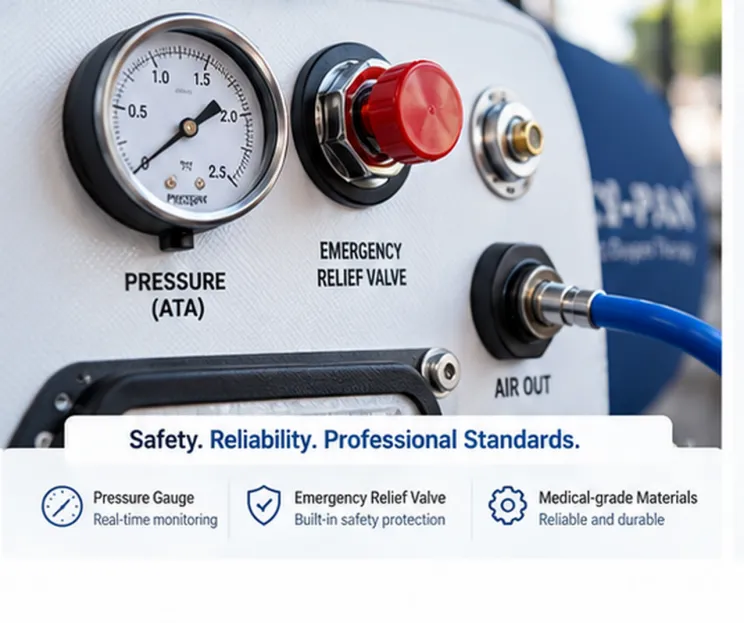
For a healthy athlete, one session is unlikely to produce the kind of structural tissue adaptation that justifies claims of accelerated healing. Some users report temporary relaxation, alertness or a subjective recovery effect, but those experiences are not equivalent to demonstrated tissue repair. Many biological responses associated with HBOT research are studied across repeated exposures.
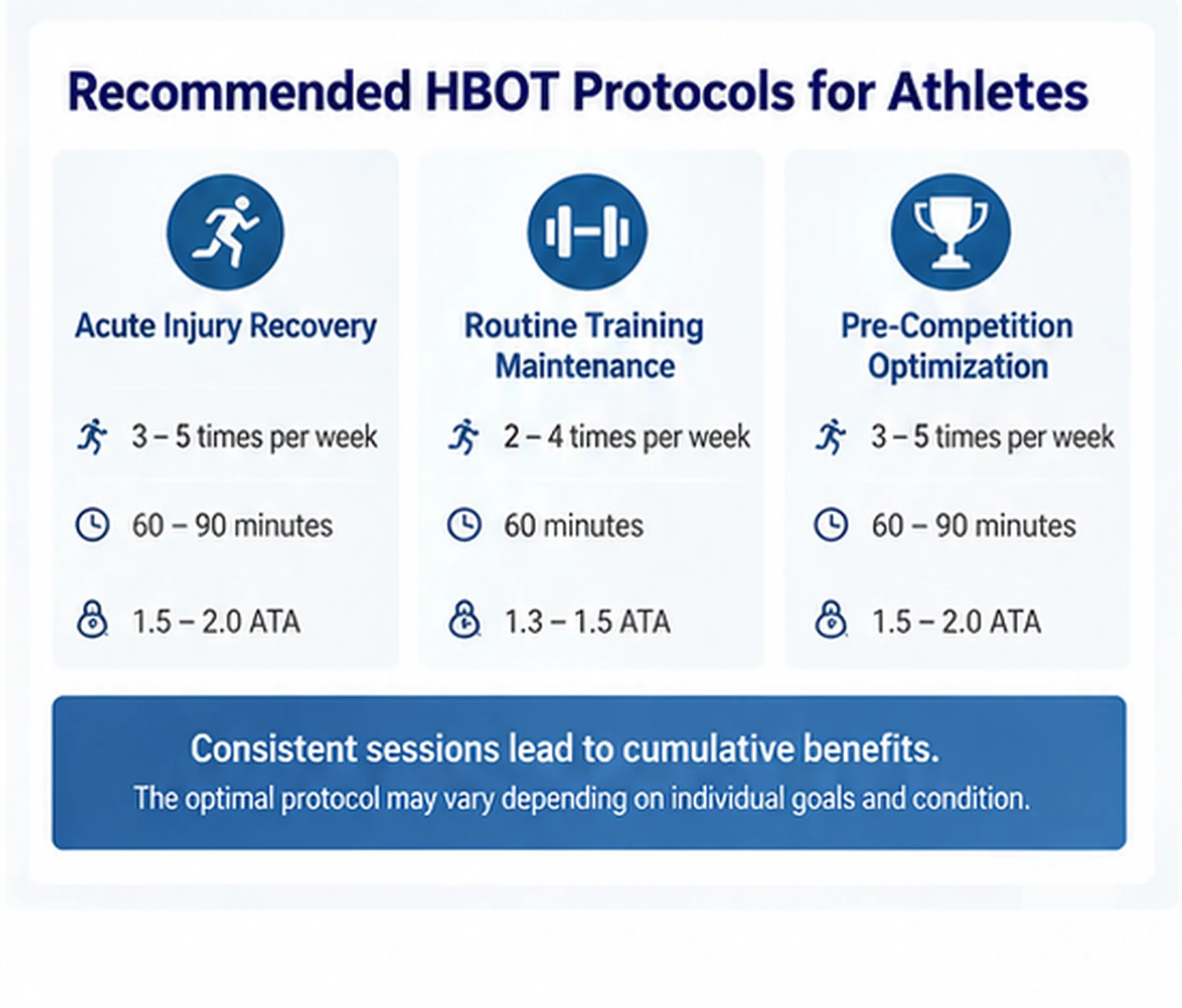
There is no universal official HBOT prescription for general athletic recovery. In commercial sports-recovery practice, schedules around 3–5 sessions per week and 60–90 minutes per session are often discussed, but this should be understood as a market/practice pattern rather than an evidence-based prescription for every athlete. Injury treatment should be directed by an appropriately qualified clinician.
Athlete HBOT Protocol Matrix
Goal | Commonly Discussed Frequency* | Session Duration* | Pressure Context* |
Acute Injury Recovery | 3–5/week | 60–90 min | Individualized; medical evaluation recommended |
Routine Training Maintenance | 2–4/week | ~60 min | Often mild-pressure consumer systems |
Pre-Competition Optimization | 3–5/week in some recovery programs | 60–90 min | Individualized; avoid experimenting immediately before competition |
*Illustrative practice patterns, not a medical prescription. Pressure, oxygen dose and frequency should be individualized.
Pressure equalization is the most immediate practical issue. During compression, the middle ear must equalize with chamber pressure. People with congestion, Eustachian-tube dysfunction or prior ear problems may experience pain and are at greater risk of barotrauma. Slower compression can help some users; a 10–15 minute pressurization period is a reasonable operational discussion point for pressure-sensitive users, but the correct rate should follow the equipment protocol and clinical guidance. Swallowing, yawning or other approved equalization techniques may help. Severe pain is a reason to stop rather than force equalization.
Endurance athletes should distinguish two different tools. Hypoxic training intentionally reduces oxygen availability to stimulate adaptation. Hyperoxia increases oxygen exposure and is used for a different physiological objective. More oxygen is not always better: excessive hyperoxic exposure can increase oxidative stress, and high-pressure oxygen carries recognized risks of oxygen toxicity. That is why pressure, oxygen dose, exposure time and recovery interval matter.
Soft chambers can feel confined, while hard-shell chambers may still provoke anxiety despite transparent windows. Compression can also increase temperature. Buyers who expect frequent use should evaluate internal dimensions, visibility, communication, ventilation/cooling options and how easily they can exit according to the system’s normal and emergency procedures.
Ear pain → slow or stop compression; use appropriate equalization techniques; do not continue through severe pain.
Congestion → postpone non-urgent use and seek clinical advice if equalization is difficult.
Overheating → use manufacturer-approved ventilation/cooling solutions and maintain room airflow.
Claustrophobia → choose a larger/transparent chamber and test the environment before purchase.
Hyperoxic exposure → do not improvise pressure or oxygen protocols; avoid unnecessarily prolonged sessions. A simple consumer rule such as “always under 120 minutes” is not a substitute for a prescribed oxygen dose.
Fire safety → follow oxygen/fire-safety rules strictly; keep ignition sources and prohibited materials away from oxygen-enriched systems.
Start with use case, not price. For routine home recovery, buyers often prioritize comfort, mild pressure, dependable airflow, oxygen-delivery quality, service support and easy entry. For applications requiring higher pressure or medical treatment, the decision belongs in a clinical pathway rather than a consumer wellness purchase.
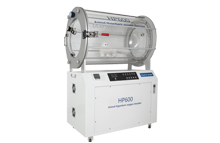
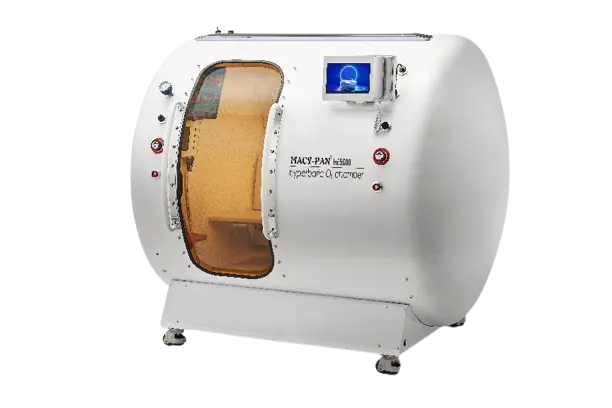
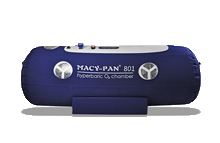
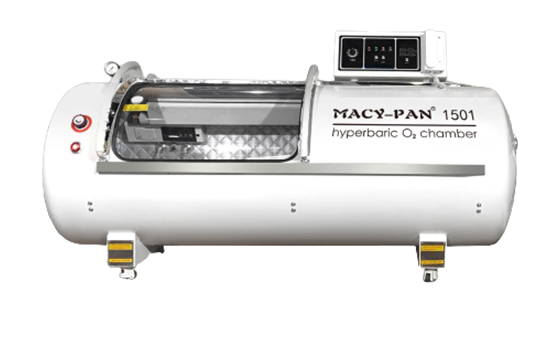
For athletes comparing home systems, MACY-PAN offers multiple hyperbaric chamber configurations. Review current specifications directly at MACY-PAN.com and request the exact operating pressure, oxygen system, dimensions, certification documentation, warranty and after-sales terms for the model you are considering.
The key buying principle is simple: do not judge a hyperbaric chamber by ATA or headline price alone. Pressure stability, oxygen delivery, safety engineering, comfort, support and the suitability of the protocol determine whether the equipment fits a serious recovery program.
HBOT is an established medical therapy for specific indications, but many sports-recovery and performance uses discussed in consumer markets are not established indications and evidence remains evolving. This article is educational and does not provide diagnosis or treatment instructions. Athletes with injuries, ear or lung conditions, implanted devices, medications, or other medical concerns should seek qualified medical advice before hyperbaric exposure. Competitor prices and specifications cited above are comparison points supplied or publicly advertised at particular times and should be independently rechecked before purchase.

Discount Price, ship by DHL, door to door service, 5-7days delivery time, local technical support

We supply soft and hard chambers from 1.3-2.0ATA to reach different customers' needs

Create custom uniquea hyperbaric chambers to reach your target market

We have more than 50 distributors around world, looking forward to having you on board.

 français
  Deutsch
  italiano
  العربية
  čeština
  Suomi
Suomi  Polska
  עברי
עברי